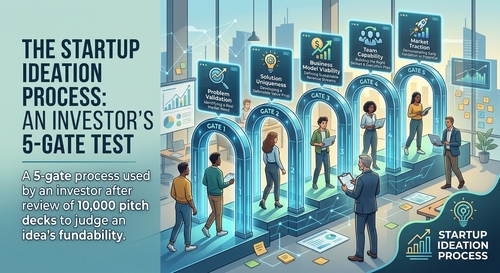
Every guide to the startup ideation process will teach you how to have ideas.
Brainstorm. Cluster your sticky notes. Run a design sprint. Look for problems you personally feel. It’s all reasonable advice, and you can get it from Harvard, Y Combinator, Antler or Founder Institute — all of whom have said it well, and all of whom rank above this page for a reason.
Here’s what none of them will tell you, because it isn’t their job.
I don’t fund ideas. I fund evidence. I’ve spent twenty years as an angel investor, backed 75 startups, and read something north of 10,000 pitch decks. In all that time, I have never once passed on a company because the idea wasn’t clever enough. I’ve passed hundreds of times because the founder couldn’t show me they’d earned the right to build it.
So this is the other half of the ideation process, the half that decides whether anyone writes you a cheque at the end of it.
What is the startup ideation process?
The startup ideation process is the structured sequence founders use to move from a raw observation about the world to a validated, fundable business concept. It has five stages: problem discovery, market interrogation, idea generation, evidence-based validation, and business model design.
Most founders treat it as a creative exercise. It isn’t. It’s a filtering exercise — and the goal is not to produce your best idea, it’s to kill your bad ones cheaply, before they cost you two years and your savings.
How long should the ideation process take?
Weeks, not months, and not a single afternoon.
An afternoon of brainstorming produces enthusiasm, not evidence. Six months of “researching” is usually procrastination wearing a lab coat. The founders I back tend to spend four to eight weeks moving through the five stages, with most of that time spent talking to potential customers rather than refining the concept in private.
What is founder-market fit, and why does it come first?
Founder-market fit is the answer to a question every investor asks silently in the first two minutes: why you?
Product-market fit is something you discover later. Founder-market fit is something you either already have or you don’t — the accumulated, specific, hard-won knowledge that makes you a more credible builder of this business than a smarter, better-funded stranger.
It is the single most under-discussed input into ideation, and the one I weight most heavily.
Why do most startup ideas fail the funding test?
Because they were validated against the founder’s enthusiasm rather than against a market.
CB Insights analysed 385 VC-backed companies that shut down since 2023. Seventy per cent ran out of capital. Forty-three per cent had poor product-market fit. Twenty-nine per cent got the timing wrong. Running out of money is what appears on the death certificate; the absence of product-market fit is usually what actually killed the patient — and product-market fit is decided at ideation, long before anyone builds anything.
You do not fix a bad idea with a good pitch deck. I’ve watched founders try for two decades.
Why the classic ideation advice quietly fails you
The standard advice isn’t wrong. It’s incomplete, in a way that costs founders years.
Firstly, it optimises for idea quality, not for evidence. Brainstorming frameworks are designed to widen the funnel. Nothing in them tells you what a sufficient amount of proof looks like before you commit — so founders exit ideation with a concept they love and no idea whether anyone will pay for it.
Secondly, it uses survivor stories as instruction manuals. Airbnb renting air mattresses. Dropbox’s demo video. These are wonderful stories and terrible templates. You are reading them precisely because they worked; the thousand founders who did the same things and disappeared didn’t get a case study. Reasoning from survivors is how you end up confidently repeating something that only worked once, in a market that no longer exists.
Thirdly, it treats “validation” as a box to tick. Twelve friendly interviews where people say “oh, that’s a great idea” is not validation. It’s a focus group of people who like you.
Lastly, it never mentions capital. Every ideation guide stops at “now build an MVP.” But whether your idea can be financed, how much it costs to reach proof, what kind of investor that implies, whether the market is big enough to return a fund, is a design constraint on the idea itself. Decide it at the end and you’ll discover you’ve built something unfundable.
The Fundable Idea Test: five gates
This is the process I actually run on my own investments and with the founders I coach. Each gate has a pass condition. If you can’t pass a gate, you don’t proceed — you go back.
Think of it as a climb. You don’t get to the summit by being enthusiastic at base camp
Gate 1: Problem discovery: find a problem with a budget attached
Most founders start with a solution and reverse-engineer a problem to justify it. Do the opposite.
Go looking for frustration that already costs someone money. Not mild annoyance. Not “wouldn’t it be nice if.” Look for the workarounds people have built — the spreadsheet held together with tape, the person hired purely to move data between two systems, the process everyone complains about in the same words.
Three places I've consistently found real problems:
- Your own operational scar tissue. The thing that made your last job miserable, that you know in granular detail.
- Regulatory or structural change. New rules create new obligations, and obligations have budgets attached.
- Workarounds in the wild. Wherever you find a manual process someone pays a human to perform, you’ve found a problem with a price already attached to it.
Here’s a workaround I see constantly, and it’s worth studying because it demonstrates the technique.
Founders know investors want a financial model, so they go and find one. They download a template built for a B2B SaaS company, subscription revenue, monthly churn, a CAC payback curve, and pour their own numbers into it. Except they aren’t a subscription business. They’re pay-as-you-go. Or they have a consulting arm and a hardware product. Or they sell the software once and service it afterwards. Every one of those has different unit economics, and none of them is the template.
The result looks professional and describes a company that doesn’t exist.
That borrowed spreadsheet is a workaround, and it points straight at a problem with a budget attached: founders without an accounting or operational background need a model that reflects their actual economics, and they can’t build one. I’ve watched that exact gap cost people rounds they should have won.
Any time you find people borrowing a tool built for someone else’s business, you’ve found a problem worth looking at.
Pass condition
You can name a specific person, in a specific role, who is currently spending money or hours on this problem, and you can say how much.
What I see from the other side of the table: a founder who describes the problem in the customer’s own vocabulary has done the work. A founder who describes it in market-report language has read about it.
Gate 2: Market interrogation: earn the right to be optimistic
Now go and find out why you’re wrong.
The instinct at this stage is to look for evidence that the market is big and growing. Resist it. Your job in Gate 2 is to find the reason this doesn’t work — and either fix it or walk away while walking away is still cheap.
Ask, in this order:
- Who solves this today, and how badly? Every problem has an incumbent solution, even if it’s a spreadsheet and stubbornness. “No competitors” almost always means “no market.”
- Why hasn’t this been solved already? There’s always a reason. It’s either a genuine barrier that has now fallen — new technology, new regulation, new behaviour — or it’s a reason your idea will fail too.
- Why now? If your idea would have worked equally well three years ago, ask why nobody did it. If it wouldn’t have worked three years ago, name exactly what changed. That answer is your whole pitch.
- How big is the reachable slice? Not the market. The slice you can actually reach with the money you can actually raise. Here’s how to do a TAM, SAM and SOM calculation properly.
Pass condition
You can state, in one sentence, what changed in the world that makes this possible now. And it has to be true.
What I see: “Why now?” is the question I ask in almost every first meeting. The number of founders who have no answer is remarkable, and it’s usually the end of the conversation.
Gate 3: Idea generation: generate against constraints, not into a void
Only now do you generate solutions — and you generate them against the constraints you uncovered in Gates 1 and 2.
An unconstrained brainstorm produces volume. A constrained one produces candidates. Give yourself the real boundaries: what you can build with the team you have, funded by the money you can realistically raise, reaching customers through a channel you can actually access.
Three techniques that survive contact with reality:
- Remix, don’t invent. Take a mechanism that works in one market and move it to another where nobody has tried it. Most successful businesses are transplants, not inventions.
- Solve for the workaround, not the problem. People have already built a hack. Your first product is often just that hack, productised and made ten times faster.
- Narrow until it hurts. “Project management for architects who work on heritage buildings” beats “project management.” Narrow markets are reachable, defensible, and — counter-intuitively — easier to raise against, because you can dominate one.
Founders get told two contradictory things
Ideas are worthless; execution is everything — ship it, release it before it’s finished. And also: it has to be unique.
So I watch founders disappear into ideation for months. Endless sessions chasing something nobody has done, until eventually they invent a solution and go looking for a problem it might fit. That is the process running backwards, and it is expensive.
Look instead for a solution that already works — powerful, relatively simple, proven — in a different sector, a different geography, or a different deployment. Then ask whether it can be adapted to a real market need in yours.
It saves you months. And it hands you an argument investors respond to: this mechanism has already been accepted once. Why not again? That’s the heart of Remix Thinking, and ideation is where it earns its keep.
Pass condition
Three to five concrete candidate solutions, each of which you could describe to a customer in a single sentence without using the word “platform.”
Gate 4: Validation: buy evidence, not compliments
This is where almost everyone cheats, and it’s the gate that separates a fundable idea from an expensive hobby.
A compliment is not evidence. When someone says “I’d definitely use that,” you have learned nothing except that they’re polite. Evidence is behaviour that costs the other person something.
In rough order of what it's worth:
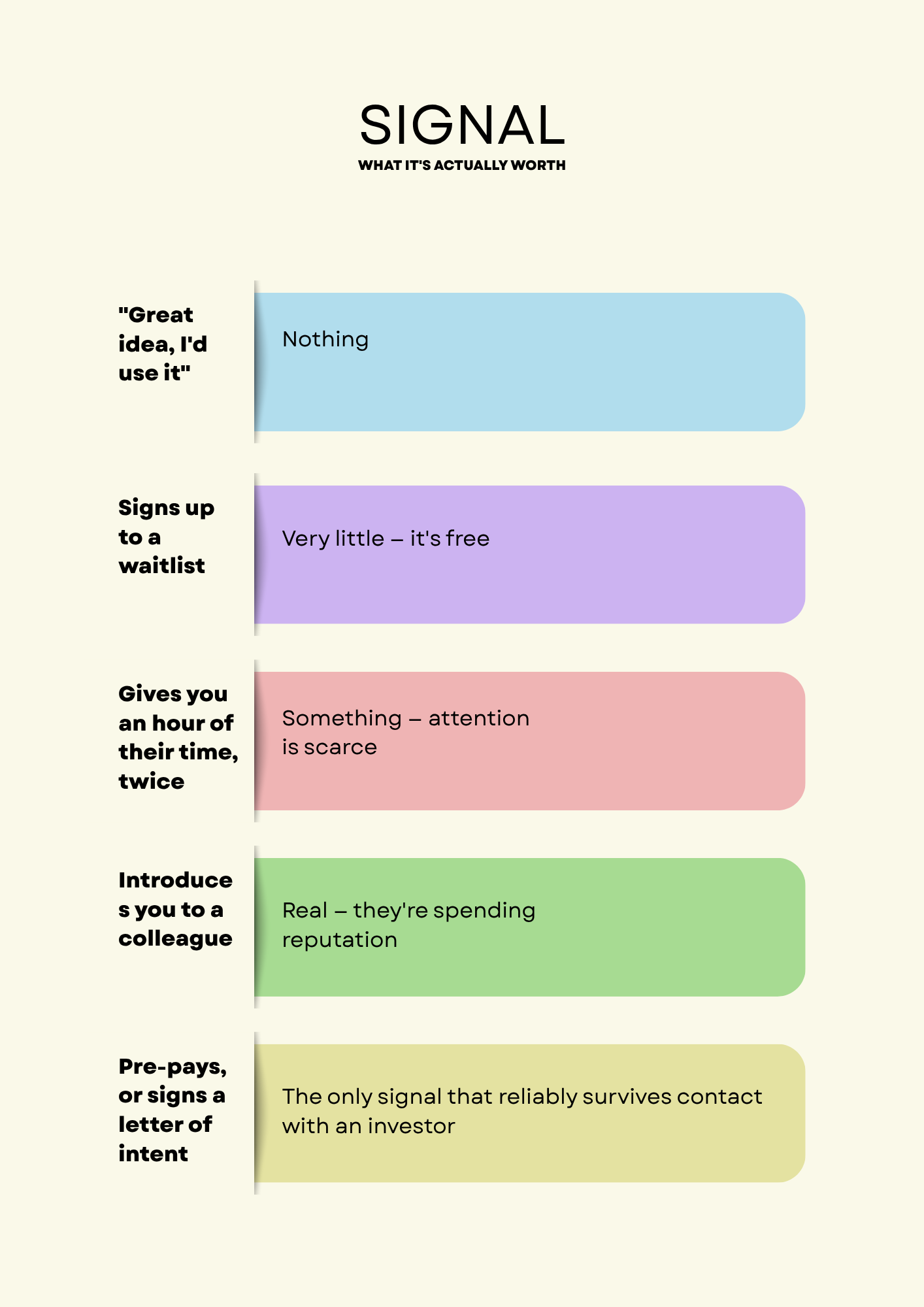
Run 20 to 30 problem interviews before you show anyone a solution. Ask about what they did last time the problem occurred, not about what they think of your idea — memory of behaviour is data, prediction of behaviour is fiction.
Then build the smallest possible thing that lets someone give you money or a firm commitment. My guide to building a rapid MVP covers how to do this in hours rather than months. And this piece on validating a startup idea goes deeper on the interview technique.
The most convincing thing I have ever been shown at this stage came from a founder in AgTech
The problem: smallholder farmers with no trusted digital certificate of title, and therefore no collateral any local bank would lend against. It’s the cascade effect. Without collateral, no loan is approved. That results in no seed and no fertiliser being purchased. And without seed and fertiliser, there is no crop. That chain is the entire difference between a season and no season for those families.
What they’d built to prove it: on-site visits, drone survey, IoT sensors, data entry, and LLM software to turn all of it into a title record a bank would actually accept.
But the technology isn’t what convinced me. What convinced me was the file.
Actual farmers. Named, counted, district by district, province by province. Not an estimate. Not a share of a market report. A list of real people they had been out and met.
That is the holy grail at the ideation stage: bottom-up SOM, not top-down TAM. They could tell me precisely who the customer was, because they had gone and stood in the field with them.
Pass condition
At least three instances of someone doing something that cost them money, time or reputation to signal demand.
What I see: I don’t need revenue at pre-seed. I need proof that you know the difference between encouragement and evidence, because that tells me what you’ll do with my money.
Gate 5: Business model design: make the money work before you need it
An idea that works but can’t be financed is not a business. It’s a project.
Four things to settle now, not after your first investor meeting:
- How you charge, and what happens as you grow. Does revenue scale faster than the cost of delivering it? If every new customer needs a new person, you have a consultancy — which is a fine business, but it isn’t venture-fundable, and you should know that before you pitch it as one.
- The cost of proof. How much capital does it take to reach the next piece of evidence that makes you worth more? That number determines the size of your raise and the kind of investor you should approach.
- The financing path this implies. Bootstrapped, angel, pre-seed, venture — these aren’t preferences, they’re consequences of your model. Here’s what investors actually look for.
- What has to be true. Write down the three assumptions that, if wrong, kill the business. Then price the cheapest experiment that tests each one.
One sentence kills more otherwise-decent ideas than anything else I hear:
“If we only capture 5% of this market, we’ll be a $100 million company in five years.”
It sounds modest. That’s the trap. The word only is doing all the work — it’s engineered to make an enormous assumption feel conservative.
But look at what it contains. Not who the first hundred customers are. Not how you reach them. Not what it costs to win one. It’s a market-size figure divided by a number the founder chose because it sounded humble.
Every investor has heard it several hundred times, and it signals exactly one thing: top-down thinking — which is the precise habit Gate 4 exists to break. Build the number from the bottom instead. This many customers, in this district, reachable through this channel, at this cost. That’s a claim an investor can test, and testable is what gets funded.
Pass condition
You can state your unit economics and the cost to reach your next milestone, on one slide, without hedging.
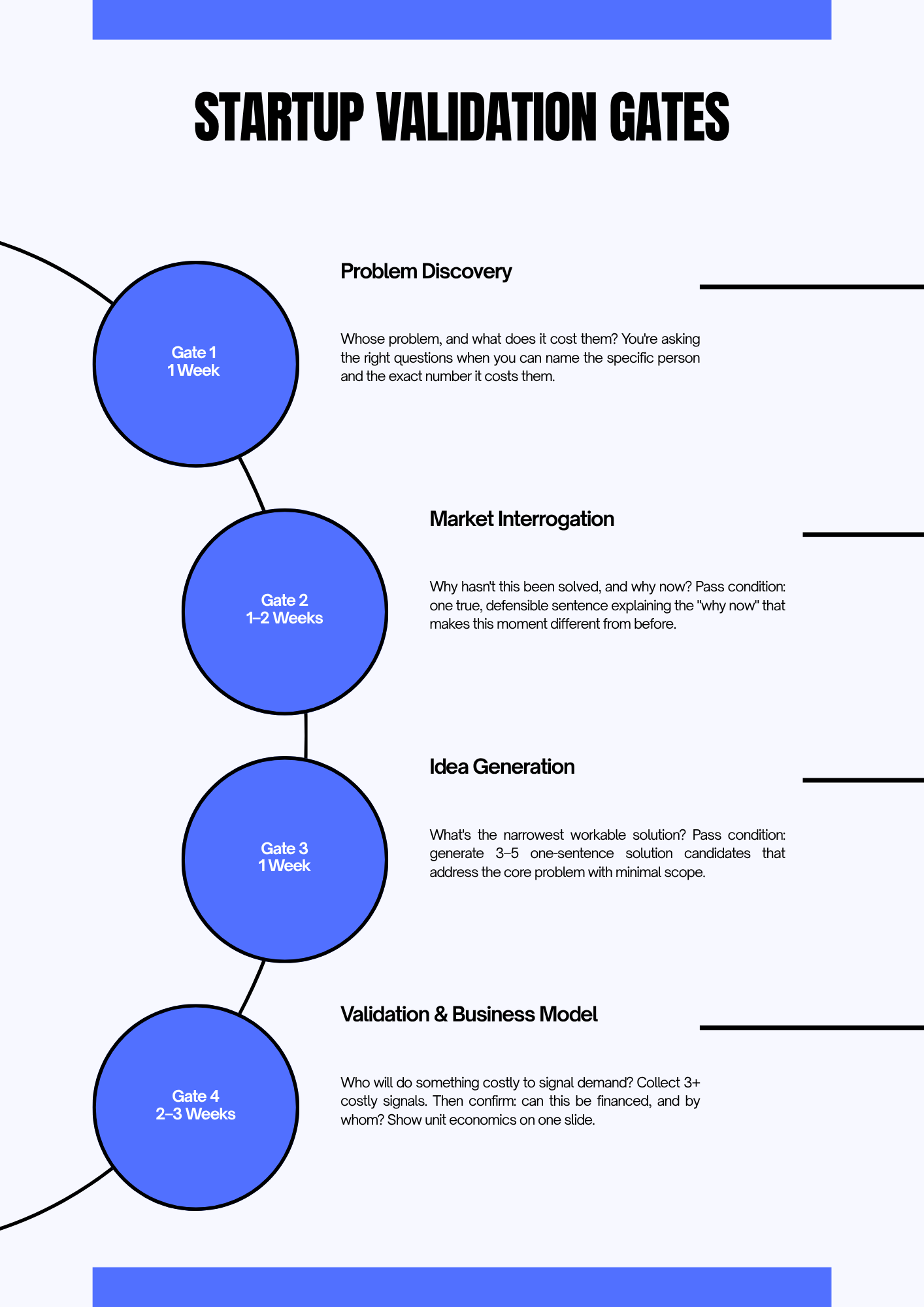
What the five gates look like as a sequence
The mistakes I see most often
Falling in love at Gate 1. The moment the idea becomes part of your identity, every subsequent gate becomes a search for confirmation. Stay cold as long as you can.
Interviewing friends. They will lie to you kindly. Talk to strangers who have the problem.
Confusing a feature with a company. A great feature that a large incumbent can ship in a quarter isn’t a business. Ask what you’ll have in two years that they can’t copy.
Skipping “why now.” If you can’t answer it, an investor will assume the market has already looked and passed.
Treating ideation as a phase you finish. You’ll re-run these gates every time you consider a pivot. The founders who do it deliberately pivot faster and cheaper than the ones who do it by panic. More on pivoting without losing momentum.
The honest summary
The startup ideation process is not a creativity workshop. It’s a sequence of increasingly expensive questions, asked in the cheapest possible order.
Do it properly and you’ll kill three bad ideas in eight weeks instead of one bad idea in three years. That’s the entire return on the exercise — not a better idea, but a much shorter distance to the truth.
And be clear about the limits of any framework, including mine. Passing all five gates doesn’t guarantee you’ll succeed. Timing, luck and execution still decide most outcomes. What it does guarantee is that you’ll walk into an investor meeting with evidence instead of enthusiasm — and after 10,000 pitch decks, I can tell you which of those two gets funded.
Where you are right now
If you’ve read this far, you probably suspect one of your gates is weaker than the rest. Most founders are right about which one.
Take the Diagnostic → — it takes a few minutes and tells you which gate you’re actually stuck at, and what to do about it.
If you’d rather talk it through, that’s what working with me is for. I’ve climbed this route a few times.
FAQ's
What are the five steps of the startup ideation process?
Problem discovery, market interrogation, idea generation, validation, and business model design. Each has a pass condition; if you can’t meet it, you go back rather than forward.
How do I validate a startup idea without building anything?
Run 20–30 problem interviews asking what people did the last time the problem occurred, then create the smallest possible commitment test — a pre-order, a letter of intent, a paid pilot. You’re looking for behaviour that costs the other person something, not opinions.
What is founder-market fit?
The specific, accumulated knowledge and credibility that make you a better builder of this particular business than a stranger with more money. Investors assess it in the first two minutes, usually silently.
How long should startup ideation take?
Four to eight weeks for most founders, with the majority of that time spent talking to potential customers rather than refining the concept privately.
Can I use this process to evaluate a pivot?
Yes — and you should. The gates work identically for a pivot, and running them deliberately is far cheaper than pivoting in a panic.